Today’s readings – Apr 29:-
NEW TESTAMENT: Luke 20:27-47 (47-27:20 Luqas)
OLD TESTAMENT: 1 Kings 6,7 (7,6 Melakim 1)
(IMPORTANT NOTE: Word meanings in the brackets are from the dictionaries, Amplified Bible (AMP), Hebrew words, Strong’s Concordance and Yah Scriptures Bible (YS) as learning aids / references. GOAL: To restore the original proper name (Isaiah 52:6) of the Only Almighty Most High True Living Creator of the universe and the name of His Son, the Messiah / Savior who was sent by Him to save the repented sinners as in John 3:16-18, John 3:3 & Matthew 3:8 which were removed and replaced with pagan words or words with bad meanings. As for the audio Bible, currently it is still the King James Version audio Bible. It will be replaced [with the audio Bible which is using the Hebrew names] someday when it is fully available)
Exodus 23:13 King James Version (KJV)
And in all things that I have said unto you be circumspect (guarded / careful / wary): and make no mention of the name of other gods, neither let it be heard out of thy (your) mouth.
EXAMPLE of RESTORATION #1: G*d is restored to Elohim (plural) / El (singular) / 𐤉𐤄𐤅𐤄 / YHUH / Yahuah (His proper name).
EXAMPLE of RESTORATION #2: J*sus Chr*st is restored to Yahusha Mashiach / Yahusha ha’Mashiach.
EXAMPLE of RESTORATION #3: L*rd / L*RD is restored to 𐤉𐤄𐤅𐤄 / YHUH / Yahuah (His proper name) / Adon / Adonai / Master depending of the context of the scripture.
EXAMPLE of RESTORATION #4: H*ly Spirit is restored to Ruach ha’Qodesh (Sacred Ruach of 𐤉𐤄𐤅𐤄 / YHUH / Yahuah the Most High Almighty One and Only Creator).
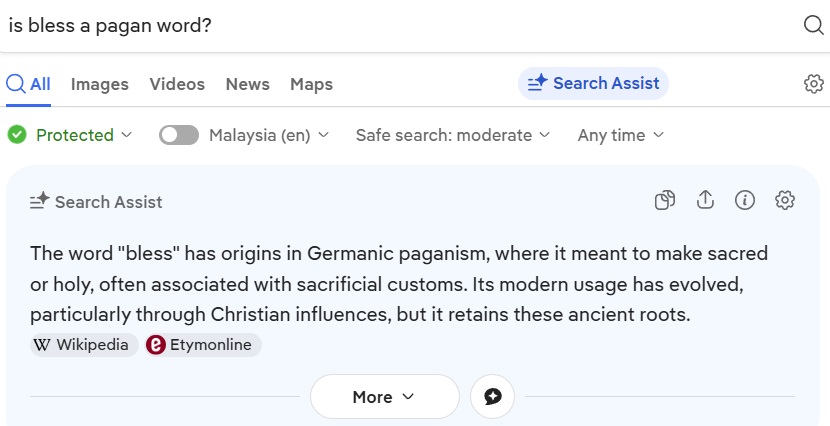
EXAMPLE of RESTORATION #5: bl*ss is restored to baruk (see the screen capture below).
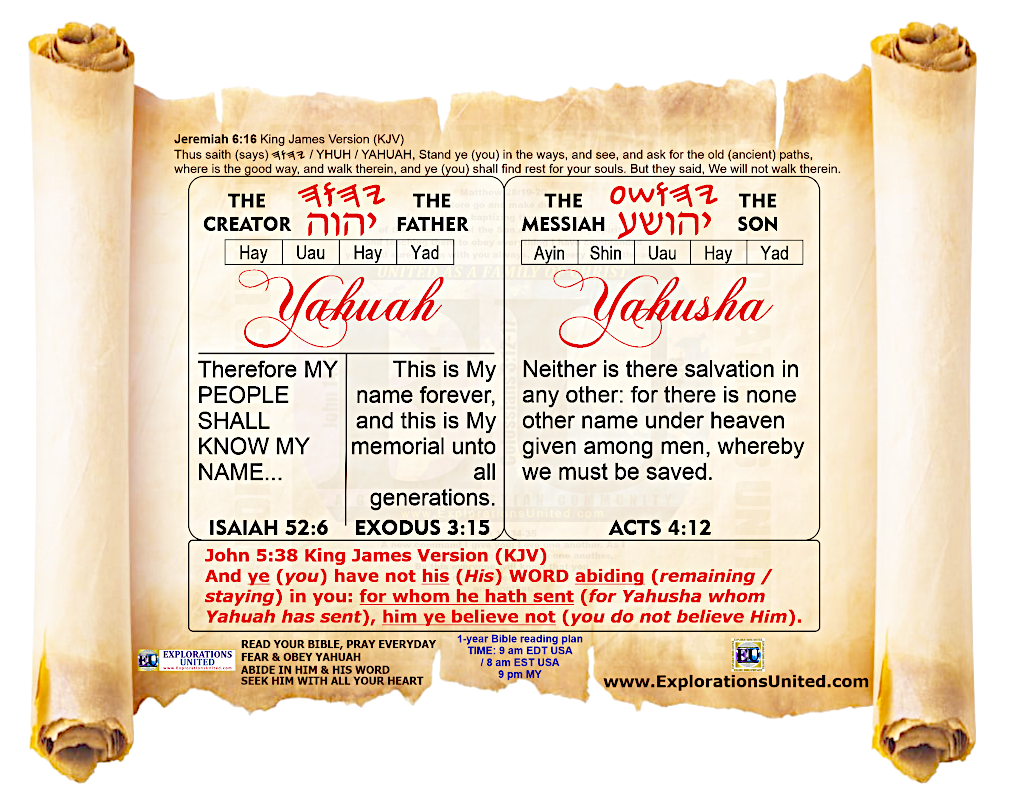
Isaiah 52:6 King James Version (KJV)
“Therefore MY PEOPLE SHALL KNOW MY NAME: therefore they shall know in that day that I am he that doth (He who does) speak: behold (See), it is I.”
(NOTE: Hebrew is read from right to left)
(Click on the banner to enlarge)
INVITATION: Come join us for the Daily Devotional Bible Study online live session (1 year reading plan – since Oct 2021). Click here for full details. You can join from whichever country you are in.
– Begin of daily reading for Apr 29 – Day 120
NEW TESTAMENT
Luke 20:27-47
King James Version audio with speed control:-
(NOTE: To pause and to play again, press Fn + F5 on your keyboard)
Background music:-
Discussion About Resurrection
27 Then came to him (Him) certain of the Sadducees, which deny that there is any resurrection; and they asked him (Him),
(NOTE: Sadducees (proper noun of a group) = Members of a Jewish sect or party of the time of Yahusha ha’Mashiach (the original name of the Messiah in the Hebrew language) that denied the resurrection of the dead, the existence of spirits, and the obligation of oral tradition, emphasizing acceptance of the written Law alone. They did not believe in any Scripture beyond the Torah, [the first five books of the Bible: Genesis, Exodus, Leviticus, Numbers, and Deuteronomy]. According to them, the Torah’s laws alone should be observed. The scripture below confirms that the Sadducees do not believe in resurrection, neither angel, nor spirit – Acts 23:8)
Acts 23:8 King James Version (KJV)
For the Sadducees say that there is no resurrection, neither angel, nor spirit: but the Pharisees confess both.)
(NOTE: resurrection (noun) = The act of restoring a dead person, for example, to life)
28 Saying, Master, Moses wrote unto us, If any man’s brother die, having a wife, and he die without children, that his brother should take his wife, and raise up seed (children) unto his brother.
29 There were therefore seven brethren (brothers): and the first took a wife, and died without children.
30 And the second took her to wife, and he died childless.
31 And the third took her; and in like manner the seven also: and they left no children, and died.
32 Last of all the woman died also.
33 Therefore in the resurrection whose wife of them is she? for seven had her to wife.
34 And Yahusha answering said unto them, The children of this world marry, and are given in marriage:
35 But they which shall be accounted worthy to obtain that world, and the resurrection from the dead, neither marry, nor are given in marriage:
36 Neither can they die any more: for they are equal unto the angels; and are the children of 𐤉𐤄𐤅𐤄 / YHUH / Yahuah, being the children of the resurrection.
37 Now that the dead are raised, even Moses shewed (showed) at the bush, when he calleth (calls) 𐤉𐤄𐤅𐤄 / YHUH / Yahuah the Elohim / Aluahym of Abraham, and the Elohim of Isaac, and the Elohim of Jacob.
38 For he is not an Elohim of the dead, but of the living: for all live unto him.
39 Then certain of the scribes answering said, Master, thou hast (you have) well said.
(NOTE: scribes (noun – plural of scribe) = Jewish learned leaders trained to write and teach the Torah, the law of Elohim / Aluahym; 𐤉𐤄𐤅𐤄 / Yahuah, the Most High Creator)
40 And after that they durst not (And they did not dare to) ask him any question at all.
Whose Son Is the Messiah?
41 And he (He) said unto them, How say they that ha’Mashiach is David’s son?
42 And David himself saith (said) in the book of Psalms, 𐤉𐤄𐤅𐤄 / YHUH / Yahuah said unto Adoni, Sit thou (you) on my right hand,
43 Till I make thine (your) enemies thy (your) footstool.
44 David therefore calleth (calls) him Adoni, how is he (He) then his son?
45 Then in the audience of all the people he (He) said unto his (His) disciples,
46 Beware of the scribes, which desire to walk in long robes, and love greetings in the markets, and the highest seats in the synagogues, and the chief rooms at feasts;
47 Which devour (consume) widows’ houses, and for a shew (show) make long prayers: the same shall receive greater damnation (condemnation / eternal punishment).
OLD TESTAMENT
1 Kings 6
King James Version audio with speed control:-
(NOTE: To pause and to play again, press Fn + F5 on your keyboard)
Background music:-
Solomon Builds the Temple
6 And it came to pass in the four hundred and eightieth year after the children of Israel were come out of the land of Egypt, in the fourth year of Solomon’s reign over Israel, in the month Zif, which is the second month, that he began to build the house of 𐤉𐤄𐤅𐤄 / YHUH / Yahuah.
2 And the house which king Solomon built for 𐤉𐤄𐤅𐤄 / YHUH / Yahuah, the length thereof was threescore (60) cubits (90 ft.), and the breadth thereof twenty (20) cubits (30 ft.), and the height thereof thirty (30) cubits (45 ft.).
3 And the porch before the temple of the house, twenty cubits was the length thereof, according to the breadth of the house; and ten cubits was the breadth thereof before the house.
4 And for the house he made windows of narrow lights.
5 And against the wall of the house he built chambers round about, against the walls of the house round about, both of the temple and of the oracle: and he made chambers round about:
6 The nethermost chamber was five cubits broad, and the middle was six cubits broad, and the third was seven cubits broad: for without in the wall of the house he made narrowed rests round about, that the beams should not be fastened in the walls of the house.
7 And the house, when it was in building, was built of stone made ready before it was brought thither: so that there was neither hammer nor axe nor any tool of iron heard in the house, while it was in building.
8 The door for the middle chamber was in the right side of the house: and they went up with winding stairs into the middle chamber, and out of the middle into the third.
9 So he built the house, and finished it; and covered the house with beams and boards of cedar.
10 And then he built chambers against all the house, five cubits high: and they rested on the house with timber of cedar.
11 And the word (Word) of 𐤉𐤄𐤅𐤄 / YHUH / Yahuah came to Solomon, saying,
12 Concerning this house which thou art (you are) in building, if thou wilt (you will) walk in my statutes, and execute my judgments, and keep all my commandments to walk in them; then will I perform my word with thee (you), which I spake unto (spoke to) David thy (your) father:
13 And I will dwell (live) among the children of Israel, and will not forsake my people Israel.
The Temple’s Interior
14 So Solomon built the house, and finished it.
15 And he built the walls of the house within with boards of cedar, both the floor of the house, and the walls of the ceiling: and he covered them on the inside with wood, and covered the floor of the house with planks of fir.
16 And he built twenty cubits on the sides of the house, both the floor and the walls with boards of cedar: he even built them for it within, even for the oracle, even for the most holy place.
17 And the house, that is, the temple before it, was forty cubits long.
18 And the cedar of the house within was carved with knops and open flowers: all was cedar; there was no stone seen.
19 And the oracle he prepared in the house within, to set there the ark of the covenant of 𐤉𐤄𐤅𐤄 / YHUH / Yahuah.
20 And the oracle in the forepart was twenty cubits in length, and twenty cubits in breadth, and twenty cubits in the height thereof: and he overlaid it with pure gold; and so covered the altar which was of cedar.
21 So Solomon overlaid the house within with pure gold: and he made a partition by the chains of gold before the oracle; and he overlaid it with gold.
22 And the whole house he overlaid with gold, until he had finished all the house: also the whole altar that was by the oracle he overlaid with gold.
23 And within the oracle he made two cherubims of olive tree, each ten cubits high.
(NOTE: cherubims (noun) = Angels with human, animal or birdlike characteristics to protect holy areas and are intimately associated with the holiness of 𐤉𐤄𐤅𐤄 / YHUH / Yahuah and the divine throne)
24 And five cubits was the one wing of the cherub, and five cubits the other wing of the cherub: from the uttermost part of the one wing unto the uttermost part of the other were ten cubits.
25 And the other cherub was ten cubits: both the cherubims were of one measure and one size.
26 The height of the one cherub was ten cubits, and so was it of the other cherub.
27 And he set the cherubims within the inner house: and they stretched forth the wings of the cherubims, so that the wing of the one touched the one wall, and the wing of the other cherub touched the other wall; and their wings touched one another in the midst of the house.
28 And he overlaid the cherubims with gold.
29 And he carved all the walls of the house round about with carved figures of cherubims and palm trees and open flowers, within and without.
30 And the floors of the house he overlaid with gold, within and without.
31 And for the entering of the oracle he made doors of olive tree: the lintel and side posts were a fifth part of the wall.
32 The two doors also were of olive tree; and he carved upon them carvings of cherubims and palm trees and open flowers, and overlaid them with gold, and spread gold upon the cherubims, and upon the palm trees.
33 So also made he for the door of the temple posts of olive tree, a fourth part of the wall.
34 And the two doors were of fir tree: the two leaves of the one door were folding, and the two leaves of the other door were folding.
35 And he carved thereon cherubims and palm trees and open flowers: and covered them with gold fitted upon the carved work.
36 And he built the inner court with three rows of hewed stone, and a row of cedar beams.
37 In the fourth year was the foundation of the house of 𐤉𐤄𐤅𐤄 / YHUH / Yahuah laid, in the month Zif:
38 And in the eleventh year, in the month Bul, which is the eighth month, was the house finished throughout all the parts thereof, and according to all the fashion of it. So was he seven years in building it.
1 Kings 7
King James Version audio with speed control:-
(NOTE: To pause and to play again, press Fn + F5 on your keyboard)
Background music:-
Solomon’s Other Buildings
7 But Solomon was building his own house thirteen years, and he finished all his house.
2 He built also the house of the forest of Lebanon; the length thereof was an hundred cubits, and the breadth thereof fifty cubits, and the height thereof thirty cubits, upon four rows of cedar pillars, with cedar beams upon the pillars.
3 And it was covered with cedar above upon the beams, that lay on forty five pillars, fifteen in a row.
4 And there were windows in three rows, and light was against light in three ranks.
5 And all the doors and posts were square, with the windows: and light was against light in three ranks.
6 And he made a porch of pillars; the length thereof was fifty cubits, and the breadth thereof thirty cubits: and the porch was before them: and the other pillars and the thick beam were before them.
7 Then he made a porch for the throne where he might judge, even the porch of judgment: and it was covered with cedar from one side of the floor to the other.
8 And his house where he dwelt had another court within the porch, which was of the like work. Solomon made also an house for Pharaoh’s daughter, whom he had taken to wife, like unto this porch.
9 All these were of costly stones, according to the measures of hewed stones, sawed with saws, within and without, even from the foundation unto the coping, and so on the outside toward the great court.
10 And the foundation was of costly stones, even great stones, stones of ten cubits, and stones of eight cubits.
11 And above were costly stones, after the measures of hewed stones, and cedars.
12 And the great court round about was with three rows of hewed (cut) stones, and a row of cedar beams, both for the inner court of the house of 𐤉𐤄𐤅𐤄 / YHUH / Yahuah, and for the porch of the house.
Furnishings of the Temple
13 And king Solomon sent and fetched Hiram out of Tyre.
14 He was a widow’s son of the tribe of Naphtali, and his father was a man of Tyre, a worker in brass: and he was filled with wisdom, and understanding, and cunning to work all works in brass. And he came to king Solomon, and wrought (worked) all his work.
15 For he cast two pillars of brass, of eighteen cubits high apiece: and a line of twelve cubits did compass either of them about.
16 And he made two chapiters of molten brass (cast bronze), to set upon the tops of the pillars: the height of the one chapiter was five cubits, and the height of the other chapiter was five cubits:
17 And nets of checker work, and wreaths of chain work, for the chapiters which were upon the top of the pillars; seven for the one chapiter, and seven for the other chapiter.
18 And he made the pillars, and two rows round about upon the one network, to cover the chapiters that were upon the top, with pomegranates: and so did he for the other chapiter.
19 And the chapiters that were upon the top of the pillars were of lily work in the porch, four cubits.
20 And the chapiters upon the two pillars had pomegranates also above, over against the belly which was by the network: and the pomegranates were two hundred in rows round about upon the other chapiter.
21 And he set up the pillars in the porch of the temple: and he set up the right pillar, and called the name thereof Jachin: and he set up the left pillar, and called the name thereof Boaz.
22 And upon the top of the pillars was lily work: so was the work of the pillars finished.
23 And he made a molten sea, ten cubits from the one brim to the other: it was round all about, and his height was five cubits: and a line of thirty cubits did compass it round about.
24 And under the brim of it round about there were knops compassing it, ten in a cubit, compassing the sea round about: the knops were cast in two rows, when it was cast.
25 It stood upon twelve oxen, three looking toward the north, and three looking toward the west, and three looking toward the south, and three looking toward the east: and the sea was set above upon them, and all their hinder parts were inward.
26 And it was an hand breadth thick, and the brim thereof was wrought (made) like the brim of a cup, with flowers of lilies: it contained two thousand baths.
27 And he made ten bases of brass; four cubits was the length of one base, and four cubits the breadth thereof, and three cubits the height of it.
28 And the work of the bases was on this manner: they had borders, and the borders were between the ledges:
29 And on the borders that were between the ledges were lions, oxen, and cherubims: and upon the ledges there was a base above: and beneath the lions and oxen were certain additions made of thin work.
30 And every base had four brasen wheels, and plates of brass: and the four corners thereof had undersetters: under the laver were undersetters molten, at the side of every addition.
31 And the mouth of it within the chapiter and above was a cubit: but the mouth thereof was round after the work of the base, a cubit and an half: and also upon the mouth of it were gravings with their borders, foursquare, not round.
32 And under the borders were four wheels; and the axletrees of the wheels were joined to the base: and the height of a wheel was a cubit and half a cubit.
33 And the work of the wheels was like the work of a chariot wheel: their axletrees, and their naves, and their felloes, and their spokes, were all molten.
34 And there were four undersetters to the four corners of one base: and the undersetters were of the very base itself.
35 And in the top of the base was there a round compass of half a cubit high: and on the top of the base the ledges thereof and the borders thereof were of the same.
36 For on the plates of the ledges thereof, and on the borders thereof, he graved cherubims, lions, and palm trees, according to the proportion of every one, and additions round about.
37 After this manner he made the ten bases: all of them had one casting, one measure, and one size.
38 Then made he ten lavers of brass: one laver contained forty baths: and every laver was four cubits: and upon every one of the ten bases one laver.
39 And he put five bases on the right side of the house, and five on the left side of the house: and he set the sea on the right side of the house eastward over against the south.
40 And Hiram made the lavers, and the shovels, and the basons. So Hiram made an end of doing all the work that he made king Solomon for the house of 𐤉𐤄𐤅𐤄 / YHUH / Yahuah:
41 The two pillars, and the two bowls of the chapiters that were on the top of the two pillars; and the two networks, to cover the two bowls of the chapiters which were upon the top of the pillars;
42 And four hundred pomegranates for the two networks, even two rows of pomegranates for one network, to cover the two bowls of the chapiters that were upon the pillars;
43 And the ten bases, and ten lavers on the bases;
44 And one sea, and twelve oxen under the sea;
45 And the pots, and the shovels, and the basons: and all these vessels, which Hiram made to king Solomon for the house of 𐤉𐤄𐤅𐤄 / YHUH / Yahuah, were of bright brass.
46 In the plain of Jordan did the king cast them, in the clay ground between Succoth and Zarthan.
47 And Solomon left all the vessels unweighed, because they were exceeding many: neither was the weight of the brass found out.
48 And Solomon made all the vessels that pertained unto the house of 𐤉𐤄𐤅𐤄 / YHUH / Yahuah: the altar of gold, and the table of gold, whereupon the shewbread was,
49 And the candlesticks of pure gold, five on the right side, and five on the left, before the oracle, with the flowers, and the lamps, and the tongs of gold,
50 And the bowls, and the snuffers, and the basons, and the spoons, and the censers of pure gold; and the hinges of gold, both for the doors of the inner house, the most holy place, and for the doors of the house, to wit, of the temple.
51 So was ended all the work that king Solomon made for the house of 𐤉𐤄𐤅𐤄 / YHUH / Yahuah. And Solomon brought in the things which David his father had dedicated; even the silver, and the gold, and the vessels, did he put among the treasures of the house of 𐤉𐤄𐤅𐤄 / YHUH / Yahuah.
– End of daily reading for Apr 29 – Day 120
> COMMENCEMENT OF A NEW BOOK (New Testament): Nil
BOOK OVERVIEW (New Testament): Luke (24 Chapters) (Original language: Greek)
Timeline: Between 58 and 65 A.D.
Author: Luke, a Gentile physician who accompanied Paul on his missions.
Objective / Purpose: Theophilus was the intended reader of this book, which aims to provide him with the complete truth on the faith’s doctrine and history as presented to him.
Audience / Attendees / Spectators / Listeners: Theophilus and all believers in Yahusha
> COMMENCEMENT OF A NEW BOOK (Old Testament): Nil
BOOK OVERVIEW (Old Testament): 1 Kings (22 Chapters) (Original language: Hebrew)
Timeline: Between 560 and 540 B.C
Author: Unknown. Possibly Jeremiah.
Objective / Purpose: The purpose of the First and Second Kings was to describe the history of the two kingdoms, Israel and Judah. In First Kings, David declares Solomon to be King. Following forty years of rule, King David passed away.
Audience / Attendees / Spectators / Listeners: The Israelites
> TODAY’S SCRIPTURE READING TOPICS OVERVIEW:-
NEW TESTAMENT:-
1) Discussion About Resurrection
2) Whose Son Is the Mashiach (Messiah)?
OLD TESTAMENT:-
1) Solomon Builds the Temple
2) The Temple’s Interior
3) Solomon’s Other Buildings
4) Furnishings of the Temple
> TODAY’S READING TOPICS (New Testament): Luke 20:27-47: 1) Discussion About Resurrection 2) Whose Son Is the Mashiach (Messiah)?
> TODAY’S READING TOPICS (Old Testament): 1 Kings 6,7: 1) Solomon Builds the Temple 2) The Temple’s Interior 3) Solomon’s Other Buildings 4) Furnishings of the Temple
ACTIVITIES
VIDEOS
(DISCLAIMER: Please take that what the owner of the video below is mentioned in the description)
VIDEO: Solomon’s Temple 3D (3 mins 42 secs)
– Messages of Christ
SONGS
DIAGRAMS
KEY POINTS
FOOTNOTES
7 Feasts of the 𐤉𐤄𐤅𐤄 / YHUH / YAHUAH, The (proper noun – name of a group of festivals) meaning in the Bible
(NOTE: 7 Feasts of the 𐤉𐤄𐤅𐤄 / YHUH / YAHUAH, The (proper noun – name of a group of festivals) = 𐤉𐤄𐤅𐤄 / YHUH / Yahuah has appointed and ordered these 7 Feasts to uphold His name. The Jewish and believers in Yahuah & Yahusha (the original Hebrew name of the Messiah) have been observing these 7 Feasts until this day)
Aḏon (title) meaning in the Bible
(NOTE: Aḏon (title) = אֲדוֹן (H113) = Lord / master / owner)
Adonai / Adonay (title) meaning in the Bible
(NOTE: Adonai / Adonay (title) = אֲדֹנָי (H136) – Pronunciation: ah-doe-NIGH = [My] Lord / Master)
Amen (adverb) meaning in the Bible
(NOTE: Amen (adverb) = אָמֵן (H543. Amen) An Abrahamic declaration of affirmation which is first found in the Hebrew Bible. It means truly/ verily)
apiece (adverb) meaning
(NOTE: apiece (adverb) = for each one: individually)
armourbearer / armor-bearer (noun) = meaning in the Bible
(NOTE: armourbearer / armor-bearer (noun) = one who carried the large shield and perhaps other weapons for a king or an assistant to leaders. It can also mean someone who supports and assists a leader especially in a war or even in a spiritual battle, helping them in their duties and responsibilities)
ascribe (verb) meaning in the Bible
(NOTE: ascribe (verb)= (1) to credit or assign (something) to a supposed cause; impute; attribute (2) to regard (something) as belonging to or coming from someone. EXAMPLE #1: Deuteronomy 32:3 Because I will publish the name of 𐤉𐤄𐤅𐤄 / YHUH / Yahuah: ascribe ye (you) greatness unto our Elohim / Aluahym. EXAMPLE #2: Job 36:3 I will fetch my knowledge from afar, and will ascribe righteousness to my Maker)
atone (intransitive verb) meaning in the Bible
(NOTE: atone (intransitive verb) = כָּפַר (H3722 – kaphar) to cover (specifically with bitumen); figuratively, to expiate / condone / placate / cancel / appease / cleanse /disannul / forgive / be merciful /pacify /pardon / purge (away) / put off / make reconciliation)
atonement (noun) meaning in the Bible
(NOTE: atonement (noun) = כָּפַר (H3722 – kaphar – a primitive root); an act to cover (specifically with bitumen); figuratively, an act to expiate or condone / placate / cancel: a cleansing, a disannulment, a forgiveness, mercy, pardon, purge (away), putting off, reconciliation). Example of usage in a sentence:Numbers 15:2525 And the priest shall make an atonementfor all the congregation of the children of Israel, and it shall be forgiven them; for it is ignorance: and they shall bring their offering, a sacrifice made by fire unto Adonai; 𐤉𐤄𐤅𐤄 / Yahuah, and their sin offering before 𐤉𐤄𐤅𐤄 / YHUH / Yahuah, for their ignorance:)
Baal (proper noun) meaning in the Bible
(NOTE: Baal / Ba’al (proper noun) = בַּעַלa (H1167) = Lord, master, owner, husband, a proper noun referring to a Canaanite deity. This Canaanite-Phoenician idol [opposite of the One True Almighty Creator / Elohim / 𐤉𐤄𐤅𐤄 / Yahuah] which looks like a cow with two horns and is associated with or equivalent Satan / Devil or His demons). An association in opposition of the One True Almighty Creator / Elohim / 𐤉𐤄𐤅𐤄 / Yahuah: Satan = שָׁלוֹם (Hebrew 7854) / Lucifer (Hebrew 1966; הֵילֵל Helel – Word origin: Halal 1984; to praise / to boast [self]) [before he was casted out from heaven] / Baphomet / Devil / Diablo [in Spanish] / Father of Lies / serpent / the enemy / Prince of the Air / Fallen Angel / morning star / shining one / Dragon / Beast / Roaring lion / The Accuser / Murderer / Beelzebub / Belial / Baalim / Antichrist and etc.)
Balaam (proper noun) meaning in the Bible
(NOTE: Balaam (proper noun) = Balaam was a wicked prophet in the Bible whose heart was not right with 𐤉𐤄𐤅𐤄 / YHUH / Yahuah (the Most High Creator). He betrayed Israel and lead them astray (Numbers 22-24)
Baalim and Ashtaroth (proper nouns) meaning in the Bible
(NOTE: Baalim and Ashtaroth (proper nouns) = The plural names of the male and female demons which originated between the streams that parts Egypt from Syrian ground and the Euphrates river. An association in opposition of the One True Almighty Creator / Elohim / 𐤉𐤄𐤅𐤄 / Yahuah: Satan = שָׁלוֹם (Hebrew 7854) / Lucifer (Hebrew 1966; הֵילֵל Helel – Word origin: Halal 1984; to praise / to boast [self]) [before he was casted out from heaven] / Baphomet / Devil / Diablo [in Spanish] / Father of Lies / serpent / the enemy / Prince of the Air / Fallen Angel / morning star / shining one / Dragon / Beast / Roaring lion / The Accuser / Murderer / Beelzebub / Belial / Antichrist and etc.)
bare false witness / bear false witness (verb – in a phrase form) meaning in the Bible
(NOTE: bare false witness / bear false witness (verb – in a phrase form) = knowingly give untrue testimony about someone)
Beelzebub (proper noun) meaning in the Bible
(NOTE: Beelzebub (proper noun) = Strong’s Concordance: H954. Beelzeboul: Original Word in Hebrew: Βεελζεβούλ, ὁ = Beelzeboul: Beelzebul, a name of Satan. Beelzebub, often referred to as the “Lord of the Flies,” is a name derived from a Philistine god worshipped in Ekron, and it later became associated with Satan in Christian theology. The name signifies a high-ranking demon or the prince of demons, representing evil spirits and is mentioned in the New Testament)
blaspheme (verb) meaning in the Bible
(NOTE: blaspheme (verb) = to speak scornful / haughty / insolent / disdainful / contemptuous / profane speech concerning Elohim / Aluahym the Most High Creator: 𐤉𐤄𐤅𐤄 / Yahuah) / Yahusha / Ruach ha’Qodesh which is the Spirit of Yahuah)
blasphemy (noun) meaning in the Bible
(NOTE: blasphemy (noun) = scornful / haughty / insolent / disdainful / contemptuous / profane speech or action concerning Elohim / Aluahym the Most High Creator: 𐤉𐤄𐤅𐤄 / Yahuah) / Yahusha / Ruach ha’Qodesh which is the Spirit of Yahuah)
circumcise (verb) meaning in the Bible
(NOTE: circumcise (verb) = to cut off the foreskin (a minor surgery) of a male / young boy / man’s genitals, especially a baby, as a religious rite, especially in Judaism and Islam, or as a medical treatment)
circumcision (noun) meaning in the Bible
(NOTE: circumcision (noun) = The act of performing a minor surgery to cut off the foreskin of a young boy or man, especially a baby, as a religious rite, especially in Judaism and Islam, or as a medical treatment)
commandment (noun) meaning in the Bible
(NOTE: commandment (noun) = A commandment is an order or directive, especially one of the biblical Ten Commandments given by 𐤉𐤄𐤅𐤄 / YHUH / Yahuah to His people, serving as guidelines for moral and spiritual conduct. It can also refer to any rule or principle that must be followed)
covetousness (noun) meaning in the Bible
(NOTE: covetousness (noun) = feeling or showing a very strong desire for something that you do not have and especially for something that belongs to someone else)
decree (noun) meaning in the Bible
(NOTE: decree (noun) = An official order issued by a legal authority)
Devil (proper noun) meaning in the Bible
(NOTE: devil (proper noun) = Satan / Lucifer (H1966; Helel: Word origin: Halal (H1984; to praise / to boast [self]) / Devil / Diablo in Spanish / Serpent / Dragon / Father of Lies / Beast / Fallen Angel / prince of the air / morning star / shining one / Antichrist; major personified spirit of evil, ruler of Hell and foe of 𐤉𐤄𐤅𐤄 / YHUH / Yahuah)
devils (noun) meaning in the Bible
(NOTE: devils (noun) = demons / fallen angels / followers of Satan / evil spirits)
edema (noun) meaning in the Bible
(NOTE: edema (noun) = A condition characterized by an excess of watery fluid collecting in the cavities or tissues of the body)
Elohim / Aluahym (noun) meaning in the Bible
(NOTE: Elohim (noun) = אֱלהִים (H430. elohim) 𐤉𐤄𐤅𐤄 / YHUH / Yahuah, gods, divine beings, judges)
farthings (noun – plural form of farthing) meaning in the Bible
(NOTE: farthings (noun – plural form of farthing) = (1) One farthing is equal to a quarter of an old penny in the former monetary unit and coin of the UK, withdrawn in 1961 (2) Something of little value)
Fruit of the Spirit (noun – metaphorical phrase) meaning in the Bible
(NOTE: Fruit of the Spirit (noun – metaphorical phrase)= A metaphorical phrase from Galatians 5:22-23 in the Bible to describe the nine (9) characteristics (or ‘fruits‘ as in Matthew 3:8) that true believers of 𐤉𐤄𐤅𐤄 / YHUH / Yahuah (the Creator), Yahusha (the Son of the Creator) & the Spirit of the Creator (Ruach ha’Qodesh) must have as an evidence / sign / proof of sincere repentance. Matthew 3:8 King James Version (KJV) Bring forth (Produce as evidence / proof / sign) therefore fruitsmeet for repentance)
SCRIPTURE REFERENCE
Galatians 5:22-23 King James Version (KJV)
22 But the fruit of the Spirit (Ruach) is love, joy, peace, longsuffering (patience), gentleness, goodness, faith,
23 Meekness (Humbleness), temperance (self-control): against such [things] there is no law.
fulfilled (verb) meaning in the Bible
(NOTE: fulfilled (verb) = completed to perfection; brought into reality)
garrison (noun) = meaning in the Bible
(NOTE: garrison (noun) = The troops stationed in a fortress or town to defend it)
Gentiles(noun / adjective) meaning in the Bible
(NOTE: Gentiles (noun / adjective) = anyone who is not of Jewish descent or who does not believe in 𐤉𐤄𐤅𐤄 / YHUH / Yahuah; heathen / pagan / nations / idolaters)
gulf (noun) meaning in the Bible
(NOTE: gulf (noun) = a deep inlet of the sea almost surrounded by land, with a narrow mouth; chasm, portal)
heifer (noun) meaning in the Bible
(NOTE: heifer (noun) = a young female cow that has not yet given birth to a calf)
Hosanna meaning in the Bible
(NOTE: Hosanna (noun) = (1) G5614. hósanna / ὡσαννά in Greek. [Hebrew origin (H3467 (יָשַׁע – save) – “Oh, save now!” or “Please save!” (2) Hebrew origin (yasha’ and na’); oh save!; hosanna (i.e. Hoshia-na), an exclamation of adoration – hosanna)
hypocrisy (noun) meaning in the Bible
(NOTE: hypocrisy (noun) = a pretense of having a virtuous character, moral or religious beliefs or principles, etc., that one does not really possess)
hypocrite (noun) meaning in the Bible
(NOTE: hypocrite (noun) = A person who pretends to be what he or she is not, or who acts contrary to their stated beliefs or opinions)
iniquity (noun) meaning in the Bible
(NOTE: iniquity (noun) = עָוֹן (H5771 – avon) immoral sin, grossly unfair behavior, fault, mischief, evil, deeply rooted planned sins, punishment of iniquity, sin; a premeditated choice to disobey 𐤉𐤄𐤅𐤄 / YHUH / Yahuah and continue without repentance)
J*sus Chr*st (proper noun) meaning in the Bible
(NOTE: J*sus Chr*st (proper noun) (IMPORTANT NOTE: Original name in Hebrew: Yahusha ha’Mashiach) = The only Son of 𐤉𐤄𐤅𐤄 / YHUH / Yahuah who is 𐤉𐤄𐤅𐤄 / YHUH / Yahuah Himself. He came down in the form of flesh [John 1:1, John 1:14] to rescue the world. Only His blood will be able to wash away the sins of those who believe in Him [1 John 1:7, Hebrews 13:12, Hebrews 9:22, Ephesians 1:7, Romans 5:9, John 14:6])
John 1:1 (KJV) – In the beginning was the Word, and the Word was with 𐤉𐤄𐤅𐤄 / YHUH / Yahuah, and the Word was 𐤉𐤄𐤅𐤄 / YHUH / Yahuah.
John 1:14 (KJV) – And the Word was made flesh, and dwelt (lived) among us, (and we beheld his glory, the glory as of the only begotten of the Father,) full of grace and truth.
(NOTE: in John 1:14, the Word (which is 𐤉𐤄𐤅𐤄 / YHUH / Yahuah as mentioned in John 1:1) was made flesh, and dwelt among us is no other than Yahusha ha’Mashiach (the Messiah) Himself).
Matthew 1:21 King James Version (KJV)
21 And she shall bring forth a son, and thou shalt (you shall) call his (His) name Yahusha: for he (He) shall save his (His) people from their sins.
Kingdom of Heaven, The (proper noun) meaning in the Bible
(NOTE: Kingdom of Heaven, The (proper noun) = the actual location where 𐤉𐤄𐤅𐤄 / YHUH / Yahuah resides)
leper (noun) meaning in the Bible
(NOTE: leper (noun) = was historically used to refer to someone who suffered from leprosy (Hansen’s disease / HD), a bacterial illness that affects the nerves, skin and respiratory tract. Leprosy is a contagious disease)
leprosy (noun) meaning in the Bible
(NOTE: leprosy (noun) = a contagious disease that affects the skin, mucous membranes, and nerves, causing discoloration and lumps on the skin and, in severe cases, disfigurement and deformities)
lier (noun) meaning in the Bible
(NOTE: lier (noun) = a person or thing that lies, as in wait or in ambush)
mammon (noun) meaning in the Bible
(NOTE: mammon (noun) = G3126: μαμωνᾶς / mamónas; money; wealth money demon; earthly goods; property; riches)
metaphor (noun) meaning
(NOTE: metaphor (noun) = a figure of speech that uses something else to describe another thing as a lesson without using the word ‘like’ or ‘as’. EXAMPLES: “He has a heart of stone.” , “He is a lion in battle.” “Life is a journey.”)
metaphorical phrase (noun) meaning
(NOTE: metaphorical phrase (noun) = Two or more words to form a figure of speech that describes one thing by stating it is another, creating a comparison without using “like” or “as.” FOR EXAMPLE, when a person is saying “He (the Creator) is my rock” (Deuteronomy 32:4, Psalm 18:2), the person explains that the Creator is the source of his / her strength and stability. Reason being a literal rock is solid, stable and strong)
mock (verb) meaning in the Bible
(NOTE: mock (verb) = tease or laugh at in a scornful or contemptuous manner)
New Testament, The (noun) meaning in the Bible
(NOTE: New Testament, The (Covenant / Agreement) (noun) = as opposed to the obsolete “old covenant of works.” The old, broken covenant of works is replaced by the so-called new covenant of grace. The Old Testament explains the covenant 𐤉𐤄𐤅𐤄 / YHUH / Yahuah established with Israel under the Law of Moses. The New Testament explains the promise that 𐤉𐤄𐤅𐤄 / YHUH / Yahuah will forgive sin and restore fellowship with those whose hearts are turned toward Him through Yahusha ha’Mashiach (the original Hebrew name of the Messiah) as the mediator)
oblation (noun) meaning in the Bible
(NOTE: oblation (noun) = the act of making a religious offering, specifically a solemn presentation or sacrifice to 𐤉𐤄𐤅𐤄 / YHUH / Yahuah, often involving gifts such as bread and wine)
oppress (transitive verb) = meaning in the Bible
(NOTE: oppress (transitive verb) = To keep (someone) in subservience and hardship, especially by the unjust exercise of authority; burden / persecute / maltreat / subdue)
palsy (noun) meaning in the Bible
(NOTE: palsy (noun) = paralysis or paresis, often accompanied by weakness and the loss of feeling and uncontrolled body movements such as shaking)
parable (noun) meaning in the Bible
(NOTE: parable (noun) = a simple story used to illustrate or explain a moral or spiritual lesson, as told by Yahusha (the original name of the Messiah in the Hebrew language) in the Gospels)
Passover (proper noun – as in the context of celebrated day / festival / event) meaning in the Bible
(NOTE: Passover (proper noun – as in the context of celebrated day / festival / event) = The most sacred holiday observed by the believers of 𐤉𐤄𐤅𐤄 / YHUH / Yahuah & Yahusha (the original name of the Messiah in the Hebrew language) to remind the day that 𐤉𐤄𐤅𐤄 / YHUH / Yahuah passed over the houses of the people of Israel (Yisrael) (10th plague – Death of Firstborn) after pharaoh refused to let go of the Israelites slaves – Exodus 12:13, Exodus 12:27. This festival lasts seven or eight days from the 15th day of Nisan. This is one of the commandments given by 𐤉𐤄𐤅𐤄 / YHUH / Yahuah Himself (Exodus 12:2). The meal for Passover on the 14th day of the month of Nisan at twilight (evening sunset) is called Seder (The Last Supper in Luke 22:1-20). The Passover lamb in Egypt foreshadows Yahusha (the original name of the Messiah in the Hebrew language), our Passover Lamb). The blood of the Passover Lamb rescued the Hebrew people from slavery [Exodus 12:1-28]. Similarly, we are freed from the slavery (bonds) of sin by the blood of Je*us (Yahusha))
Passover, Feast of the (proper noun – as in the context of celebrated day / festival) meaning in the Bible
(NOTE: Passover, Feast of the (proper noun – as in the context of celebrated day / festival) = A sacred holiday observed by the believers of 𐤉𐤄𐤅𐤄 / YHUH / Yahuah in Spring. This is to remind the day that 𐤉𐤄𐤅𐤄 / YHUH / Yahuah passed over the houses of the people of Israel (Yisrael) during the 10th plague (death of firstborn) after pharaoh refused to let go of the Israelites slaves (Exodus 12:13, Exodus 12:27). This festival lasts seven or eight days from the 15th day of Nisan. This is one of the commandments given by 𐤉𐤄𐤅𐤄 / YHUH / Yahuah Himself (Exodus 12:2). The meal for Passover on the 14th day of the month of Nisan at twilight (evening sunset) is called Seder (The Last Supper in Luke 22:1-20). The Passover lamb in Egypt foreshadows Yahusha (the original name of the Messiah in the Hebrew language) our Passover Lamb. The blood of the Passover Lamb rescued the Hebrew firstborn from death [Exodus 12:1-28] during the execution of the 10th plague. Similarly, we are freed from the slavery (bonds) of sin by the blood of Yahusha (the original name of the Messiah in the Hebrew language))
Pharaoh (noun) meaning in the Bible
(NOTE: Pharaoh (noun) = The supreme ruler of ancient Egypt; a formal address for the sovereign seat of power as personified by the ‘king’ in an institutional role of Horus son of Osiris; often used by metonymy for Ancient Egyptian sovereignty)
Pharisee (proper noun of an ancient Jewish group) meaning in the Bible
(NOTE: Pharisee (proper noun of an ancient Jewish group) = A member of a Jewish group that separated from other Jews and followed strictly the oral law of the Old Testament in ancient Judaism. They separated themselves from impurity and opposed the Messiah / the Son of the Almighty Creator / Yahusha ha’Mashiach (the original name of the Messiah in the Hebrew language) and argued with Him very often)
Pharisees (proper noun – plural of Pharisee) meaning in the Bible
(NOTE: Pharisees (proper noun – plural of Pharisee) = a Jewish group that separated from other Jews and followed strictly the oral law of the Old Testament in ancient Judaism. They separated themselves from impurity and opposed the Messiah / the Son of the Almighty Creator / Yahusha ha’Mashiach (the original name of the Messiah in the Hebrew language) and argued with Him very often)
plains (noun) meaning in the Bible
(NOTE: plains (noun) = a large area of flat land with few trees)
prophesy (verb) meaning in the Bible
(NOTE: prophesy (verb) = to foretell the future, to speak a new message from 𐤉𐤄𐤅𐤄 / YHUH / Yahuah to the people)
Example usage in a sentence: Prophets prophesy. They tell us what 𐤉𐤄𐤅𐤄 / YHUH / Yahuah is telling us (the message from Him) / what He wants us to do / what He has shown them of the coming events in the future)
repent (verb) meaning in the Bible
(NOTE: repent (verb) = to have a change of mind regarding sins > with sincere regret or remorse that leads to turning away from sin, > stop repeating the same sin, > turning towards 𐤉𐤄𐤅𐤄 / YHUH / Yahuah, > asking forgiveness from 𐤉𐤄𐤅𐤄 / YHUH / Yahuah > & bearing the fruit / evidence in keeping of repentance (Matthew 3:8 Bring forth therefore fruits meet for repentance). In the Old Testament, the Hebrew word for repent is “נָחַם” (nacham). It means to be sorry, to console oneself, or to change one’s mind. In the New Testament, the Greek word for repent is “μετανοέω” (metanoeō). It means to change one’s mind or purpose, often with the implication of turning away from sin and turning towards 𐤉𐤄𐤅𐤄 / YHUH / Yahuah)
repentance (noun) meaning in the Bible
(NOTE: repentance (noun) = the action of having a change of mind regarding sins, of regretting and changing one’s wrongdoing or sin, the fact of showing that you are very sorry [being remorseful] for something bad / sinful / evil / wicked you have done in the past which leads to asking Elohim / Aluahym; 𐤉𐤄𐤅𐤄 / Yahuah (the Most High Creator) for forgiveness and stop repeating the same sin; penitence)
resurrection (noun) meaning in the Bible
(NOTE: resurrection (noun) = The act of restoring a dead person, for example, to life)
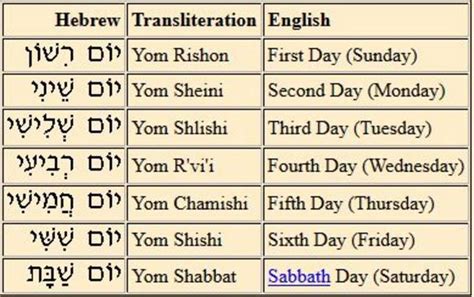
Sabbath Day (proper noun – name of the day of the week) meaning in the Bible
(NOTE: Sabbath Day (proper noun – name of the day of the week) = Hebrew: שַׁבָּת. Transliteration: shabbath. Sabbath = Seventh day / Saturday / Yom Shabbat / Sunset on Friday to sunset on Saturday. In accordance with Exodus 20:8–11, the Almighty Creator Himself commanded that the seventh day of the week to be kept holy as the Sabbath Day (COMMANDMENT #4). The purpose of this day of rest is to remind the children of Israel (Yisrael) that 𐤉𐤄𐤅𐤄 / YHUH / Yahuah created the universe in six days and then rested on the seventh day. The Jews observe this holy day of rest (Sabbath day) from sunset on Friday until dusk on the following day while some believers of Yahuah and Yahusha observe this holy day of rest from dawn to dawn as in Genesis 1:3-5 (King James Version) 3 And 𐤉𐤄𐤅𐤄 / YHUH / Yahuah said, Let there be light: and there was light. 4 And 𐤉𐤄𐤅𐤄 / YHUH / Yahuah saw the light, that it was good: and 𐤉𐤄𐤅𐤄 / YHUH / Yahuah divided the light from the darkness. 5 And 𐤉𐤄𐤅𐤄 / YHUH / Yahuah called the light Day, and the darkness he called Night. And the evening and the morning were the first day.)
DIAGRAM: Days of the Week in Hebrew – by Phillip Perry
Sadducees (proper noun) meaning in the Bible
(NOTE: Sadducees (proper noun) = Members of a Jewish sect or party of the time of Yahusha ha’Mashiach (the original name of the Messiah in the Hebrew language) that denied the resurrection of the dead, the existence of spirits, and the obligation of oral tradition, emphasizing acceptance of the written Law alone. They did not believe in any Scripture beyond the Torah, [the first five books of the Bible: Genesis, Exodus, Leviticus, Numbers, and Deuteronomy]. According to them, the Torah’s laws alone should be observed. The scripture below confirms that the Sadducees do not believe in resurrection, neither angel, nor spirit – Acts 23:8)
Acts 23:8 King James Version (KJV)
For the Sadducees say that there is no resurrection, neither angel, nor spirit: but the Pharisees confess both.
salvation (noun) meaning in the Bible
(NOTE: salvation (noun) = the deliverance/rescue from eternal punishment for sin, provided by the grace (the free and unmerited favour) of 𐤉𐤄𐤅𐤄 / YHUH / Yahuah, to those who accept His terms of repentance and faith in the Yahusha ha’Mashiach)
sanctuary (noun ) meaning in the Bible
(NOTE: sanctuary (noun) = a consecrated place; such as: (a) the ancient Hebrew temple at Jerusalem or its holy of holies. OR (b) the most sacred part of a religious building (such as the part of a Christian church in which the altar is placed)
Satan (proper noun) meaning in the Bible
(NOTE: Satan (proper noun) = שָׁלוֹם (H7854) / Lucifer (H1966; הֵילֵל Helel – Word origin: Halal (H1984; to praise / to boast [self]) [before he was casted out from heaven] / Baphomet / Devil / Diablo [in Spanish] / Father of Lies / serpent / the enemy / Prince of the Air / Fallen Angel / morning star / shining one / Dragon / Beast / Roaring lion / The Accuser / Murderer / Beelzebub / Baal / Ba’al / Belial / Antichrist)
score, a (numerical value, archaic) meaning in the Bible
(NOTE: a score (numerical value, archaic) = 20)
scribes (noun – plural of scribe) meaning in the Bible
(NOTE: scribes (noun – plural of scribe) = Jewish learned leaders trained to write and teach the Torah, the law of Elohim / Aluahym; 𐤉𐤄𐤅𐤄 / YHUH / Yahuah, the Most High Creator)
scrip (noun) meaning in the Bible
(NOTE: scrip (noun) = 1 Samuel 17:40 describes this small bag that is attached to the girdle as “a shepherd’s pouch”. 1 Samuel 17:40 (KJV) And he took his staff in his hand, and chose him five smooth stones out of the brook, and put them in a shepherd’s bag which he had, even in a scrip; and his sling was in his hand: and he drew near to the Philistine.)
shake the dust off your feet (idiom) meaning in the Bible
(NOTE: shake the dust off your feet (idiom) = “Shake the dust off your feet” means to show disassociation or rejection of a place or those who rejected Elohim’s truth, often used in a religious context to signify moving on from those who reject the message of faith. It originates from the New Testament, where Yahusha (the original name of the Messiah / Son of Yahuah) instructed his disciples to perform this act as a testimony against those who rejected Elohim’s truth)
shalom (interjection) meaning in the Bible
(NOTE: shalom (interjection) = שָׁלוֹם (H7965) = Peace, completeness, welfare, well-being, safety, prosperity. Used as a traditional Jewish greeting or farewell)
shepherd (noun) meaning in the Bible
(NOTE: shepherd (noun) = A person who tends and rears sheep)
Sodom and Gomorrha (Gomorrah) (proper nouns) meaning in the Bible
(NOTE: Sodom and Gomorrha (Gomorrah) (proper nouns) = The twin cities that 𐤉𐤄𐤅𐤄 / YHUH / Yahuah (the Most High Creator) destroyed completely due to sexual immoral sins (homosexuality) – Genesis 19)
sodomite (noun) meaning in the Bible
(NOTE: sodomite (noun) = a person who engages in sodomy)
sojourn (verb) meaning in the Bible
(NOTE: sojourn (verb) = To stay / reside temporarily)
spikenard (noun) meaning in the Bible
(NOTE: spikenard (noun) = costly perfumed ointment much valued in ancient times)
spoil (noun) meaning in the Bible
(NOTE: spoil (noun) = goods stolen or taken forcibly from a person or place)
stake (noun) meaning in the Bible
(NOTE: stake (noun) = יָתֵד (H3489 . yathed / G4716. stauros) stick / pole)
statute (noun) meaning in the Bible
(NOTE: statute (noun) = חֻקָּה (H2708 . chuqqah) a written law passed by a legislative body; ordinance / decree / regulation / written law)
swaddling clothes (noun) meaning in the Bible
(NOTE: swaddling clothes (noun) = square clothes used to wrap around a newborn infant to hold its legs and arms still)
synagogue (noun) meaning in the Bible
(NOTE: synagogue (noun) = the building where a Jewish assembly or congregation meets for religious worship and instruction)
transgression (noun) meaning in the Bible
(NOTE: transgression (noun) = an act that goes against a law, rule, or code of conduct / moral principle; breach / offense)
tabernacle (noun) meaning in the Bible
(NOTE: tabernacle (noun) = (in Biblical use) a fixed or movable habitation, typically of light construction (a portable and ornate tent shrine); Tabernacle literally means ‘place of dwelling‘ and was so called in the belief that 𐤉𐤄𐤅𐤄 / YHUH / Yahuah literally lived within its sacred confines. When Israel (Yisrael) camped, the tabernacle was set up in the precise center of the camp (symbolizing the idea that 𐤉𐤄𐤅𐤄 / YHUH / Yahuah was to be the center of his people’s lives)
temple (noun) meaning in the Bible
(NOTE: temple (noun) = מִקְדָּשׁ (H4720 in Hebrew, miqdash or miqqedash) means sanctuary / a consecrated thing or place)
tetrarch (noun) meaning in the Bible
(NOTE: tetrarch (noun) = (in the Roman Empire) the governor of one of four divisions of a country or province)
tithe (noun) meaning in the Bible
(NOTE: tithe (noun) = One tenth of annual produce or earnings taken as a tax for the support of the church and clergy)
transfigured (verb – simple past tense and past participle of transfigured) meaning in the Bible
(NOTE: transfigured (verb – simple past tense and past participle of transfigured) = transformed into something more beautiful or elevated)
trespass (intransitive verb) meaning in the Bible
(NOTE: trespass (intransitive verb) = מַעַל (H4604 – maal) unfaithfulness / treachery / trespass / transgression, wrongdoing / offence / breach of law / misconduct)
viper (noun) meaning in the Bible
(NOTE: viper (noun) = A venomous snake with large hinged fangs, typically having a broad head and stout body, with dark patterns on a lighter background)
wilderness (noun) meaning in the Bible
(NOTE: wilderness (noun) = an uncultivated, uninhabited and inhospitable region; wild, backwoods)
THE PROPER HEBREW NAME OF THE ALMIGHTY CREATOR
Isaiah 52:6 King James Version (KJV)
“Therefore MY PEOPLE SHALL KNOW MY NAME: therefore they shall know in that day that I am he that doth (He who does) speak: behold, it is I.”
The word ‘God’ is a noun. It is not the Most High Creator’s actual name.
EXAMPLE: “He is my father. He drives me to school every morning. His name is Johnny Lim.”
EXPLAINED: The word ‘father’ here is a noun. It is not the actual / proper name. ‘Johnny Lim’ is the actual / proper name.
QUESTION: What is the Creator’s actual / proper name?
ANSWER: The Creator’s actual name is as follows:-
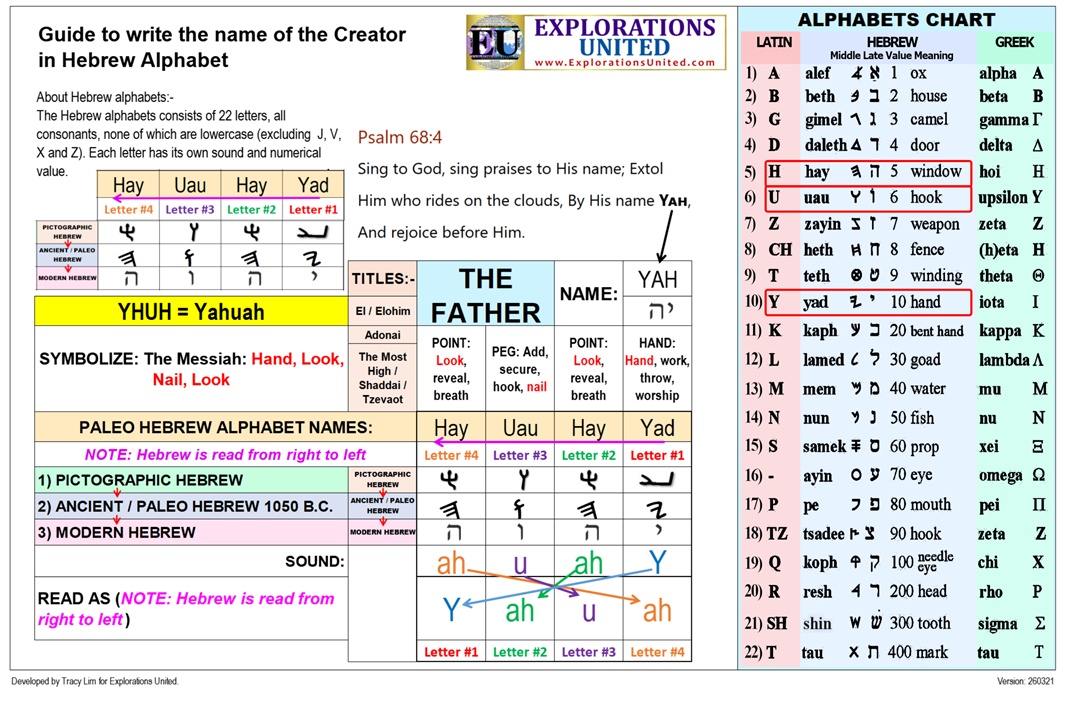
(NOTE: YHUH (proper noun) = 𐤉𐤄𐤅𐤄 is the proper name of the Creator. יהוה (H3068) in tetragrammaton: י (yad) ה (hay) ו (uau ) ה (hay)
IMPORTANT NOTE: Hebrew text is read from RIGHT to LEFT:-

(Click to enlarge)
THE ORGINAL HEBREW NAME OF THE MESSIAH
| Ancient / Paleo Hebrew | 𐤉𐤄𐤅𐤔𐤏 (Yahuah is Salvation) | 𐤌𐤔𐤉𐤇 (Messiah) |
| Modern Hebrew | יהושע (Yahusha = Yahuah is Salvation) | המשיח (ha‘Mashiach = The Anointed One) |
| Romanized (NOTE: Hebrew text is read from right to left) | Yahusha | ha‘Mashiach |
Yahusha (J*sus) was anointed by 𐤉𐤄𐤅𐤄 / YHUH / Yahuah as the Savior / Messiah to save the sinners for those who believe in Him.
THE ORGINAL HEBREW NAME OF THE MESSIAH WAS TRANSLITERATED ALONG THE YEARS
TRANSLATION VS TRANSLITERATION
Translation involves converting text from one language to another while preserving its meaning, context, and tone.
In contrast, transliteration focuses on converting text from one script to another, maintaining the original sounds WITHOUT CONVEYING the meaning.
THE ORGINAL HEBREW NAME OF THE MESSIAH WAS TRANSLITERATED ALONG THE YEARS
1) יהושע (H3091) romanized = Yahusha = 𐤉𐤄𐤅𐤄 / YHUH / Yahuah saves
⬇ transliterated
into Greek as Iēsous (Ἰησοῦς)
⬇ transliterated
into Latin as Iesus
⬇ transliterated
into English as Jesus
2) משיח (H4899) romanized : Mashiach = Anointed One / Messiah / Savior / Chosen One to save the sinners
⬇ transliterated
into Greek as Christos (Χριστός)
⬇ transliterated
into Latin as Christus
⬇ transliterated
into English as Christ
Therefore the FULL NAME of the Messiah in Hebrew alphabets is:-
IMPORTANT NOTE: Hebrew text is read from RIGHT to LEFT:-
יהושע המשיח (Hebrew) = Yahusha ha‘Mashiach

*** DIFFERENT SPELLING VERSIONS OF THE MESSIAH:-
Here are the explanations. PLEASE PAY ATTENTION TO EACH DETAIL EXPLAINED:-
1. SPELLING VERSION #1:-
Yeshua יֵשׁוּעַ (H3442) is a shortened form of Yehoshooah / Yahushua יְהוֹשׁוּעַ (H3091). EXAMPLE #1: Mike is a shortened form of Michael. EXAMPLE #2: Josh is a shortened form of Joshua.
QUESTION: Does anyone like their name to be shortened? ANSWER: No.
QUESTION: Were our names shortened in any legal documents? ANSWER: No.
QUESTION: Is ‘Ye’ the name of the Creator? ANSWER: No, it is not. It is Yah יה (H3050 < י (y = Yad) & הּ (ah = Hay).
2. SPELLING VERSION #2:-
Yehoshooah / Yehushua יְהוֹשׁוּעַ (H3091) as spelled in this manner with the niqqud as a pronunciation guide.
shua שוע (H7769) = to cry out > ש (sh = Shan / Shin) + u ו (u = Uau) + ע (a = Ayin)
QUESTION: If the Messiah came in the name of His Father (Yah) as in John 5:43, will it make sense that the Messiah’s name be “Yehoshooah” / “Yehushua” / “Yehusha”? ANSWER: No.
QUESTION: Is ‘Yeh’ the name of the Creator? ANSWER: No, it is not. It is Yah יה (H3050 < י (y = Yad) & הּ (ah = Hay).
QUESTION: Does this spelling version form the meaning of the Creator saves? ANSWER: No, it doesn’t.
3. SPELLING VERSION #3:-
Yahushua יהושוע (H3091) as spelled in this manner (without the niqqud) depicts the Messiah came in the name of His Father, Yah יה (H3050) means The Creator. Yahushua means Yah [I] cry out.
Yah יה (H3050) is made of י (y = Yad) & הּ (ah = Hay) which means YAH (יה = The Creator),
u ו (u = Uau) = add
shua שוע (H7769) = to cry out > ש (sh = Shan / Shin) + u ו (u = Uau) + ע (a = Ayin)
QUESTION: Does this spelling version form the meaning of the Creator saves? ANSWER: No, it doesn’t, because shua שוע (H7769) means ‘to cry out’.
4. SPELLING VERSION #4:-
Yahusha (יהושע) as spelled in this manner (before the niqqud was created) depicts the Messiah came in the name of His Father and according to the original Pictographic Hebrew. Yahusha means Yahuah saves.
Yah יה (H3050) is made of י (y = Yad) & הּ (ah = Hay) which means YAH (יה = The Creator),
u ו (u = Uau) = add
sha שע (sh = Shan / Shin) + ע (a = Ayin) (NOTE: The ‘sha‘ here comes from the root word Yasha)
ROOT WORD: Yasha ישע (H3467) = to save / deliver / rescue > י (y = Yad) & הּ (ah = Hay) + ש (sh = Shan / Shin) + ע (a = Ayin).
SUMMARY: Only the spelling of ‘Yahusha‘ from SPELLING VERSION #4 shows the meaning of the Creator / Yahuah saves.
See the diagram below (in Pictograph Hebrew, Ancient / Paleo Hebrew and Modern Hebrew letters):-
THE NAME OF THE MESSIAH
IMPORTANT NOTE: Hebrew text is read from RIGHT to LEFT:-
(Click to enlarge)
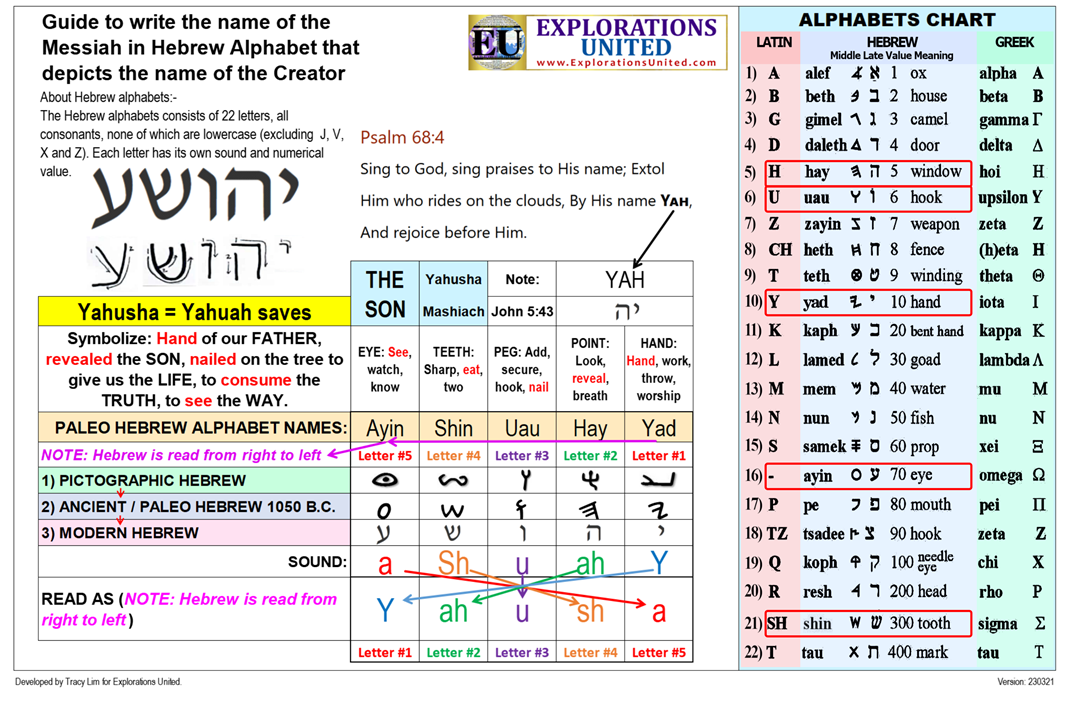


DIAGRAM: Ancient Hebrew Alphabet Chart
ACKNOWLEDGMENT: Many thanks to Ancient Hebrew Education Center for the diagram below:-

ARTICLE
THE NAMES OF THE CREATOR AND HIS SON: https://www.explorationsunited.com/the-names-of-the-creator-and-his-son
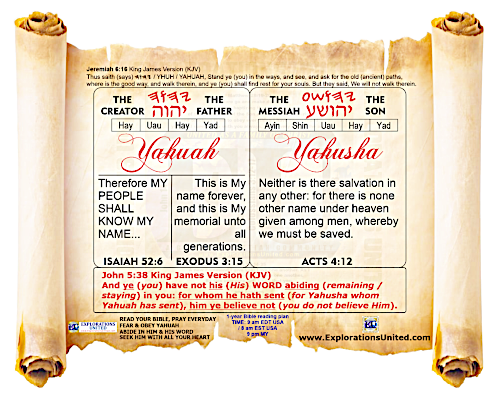
GUIDE TO BE A BELIEVER / TO BE SAVED
To accept Yahusha ha’Mashiach (original name in Hebrew of the Messiah) as your personal Savior and Master. Click here.
May Abba Father Yahuah keep you and your family always.
EXPLORATIONS UNITED
| Lookup a word or passage in the Bible |
|---|
|
|

HOME | ABOUT US | CHATWALL | BIBLE 365 (with audio) | CHATROOMS | EVENTS | RESOURCES | CHRISTIAN SONGS & MUSIC | LIFE TIPS

QR Code for EXPLORATIONS UNITED’s website:-


SCRIPTURE REFERENCES FOR SPIRITUAL AWAKENING
Here are some important Scripture references for spiritual awakening. Please remember to read your Holy Bible and pray everyday because this is how our heavenly Father speaks to us. Make sure you read the entire Holy Bible. Write down each and every commandment, statute (written law) and instruction given by 𐤉𐤄𐤅𐤄 / YHUH / Yahuah in His Word. Obey and practice ALL OF THEM.
Having difficulties to discipline yourself to read the Holy Bible daily? Then you are in trouble! Stop deceiving yourselves!
WARNING from 𐤉𐤄𐤅𐤄 / YHUH / Yahuah Himself: The Word of 𐤉𐤄𐤅𐤄 / YHUH / Yahuah warned that if we do not have His word abiding (remaining) in us, then we are NOT believers (NOT saved)! WAKE UP PEOPLE! Read John 5:38:-
John 5:38 King James Version (KJV)
And ye (you) have not his word (His Word) abiding (remaining) in you: for whom he hath (He / Yahuah has) sent, him ye believe not (Him you not believe).
Revelation 22:14 King James Version (KJV)
14 Baruk are they that do his (His) commandments, that they may have right to the tree of life, and may enter in through the gates into the city.
James 1:22 King James Version (KJV)
But be ye (you) doers of the word (Word), and not hearers only, deceiving your own selves.
Galatians 6:7 King James Version (KJV)
Be not deceived; 𐤉𐤄𐤅𐤄 / YHUH / Yahuah is not mocked: for whatsoever a man soweth (sows / puts in / plants / spreads), that shall he also reap (harvest / attain / get).
Galatians 6:3 King James Version (KJV)
For if a man think himself to be something, when he is nothing, he deceiveth (deceives / is deceiving) himself.
1 Corinthians 15:33 King James Version (KJV)
Be not deceived: evil communications corrupt good manners.
Colossians 2:8 King James Version (KJV)
Beware lest any man (Beware, otherwise others may) spoil you through philosophy and vain deceit (deception), after the tradition of men, after the rudiments of the world, and not after Mashiach (following the elementary principles of this world, rather than following [the truth—the teachings of] Mashiach).
1 Thessalonians 5:11 King James Version (KJV)
“Wherefore comfort yourselves together, and edify one another, even as also ye (you) do.”
Hebrews 3:13 King James Version (KJV)
But exhort one another daily, while it is called To day; lest any of you be hardened through the deceitfulness of sin.
John 7:27 King James Version (KJV)
Judge not according to the appearance, but judge righteous judgment.
Matthew 7:1-5 King James Version (KJV)
1 Judge not, that ye (you) be not judged.
(AMP BIBLE: 1 Do not judge and criticize and condemn [others unfairly with an attitude of self-righteous superiority as though assuming the office of a judge], so that you will not be judged [unfairly].)
2 For with what judgment ye (you) judge, ye (you) shall be judged: and with what measure ye mete (you punish), it shall be measured to you again.
(AMP BIBLE: 2 For just as you [hypocritically] judge others [when you are sinful and unrepentant], so will you be judged; and in accordance with your standard of measure [used to pass out judgment], judgment will be measured to you.)
3 And why beholdest thou the mote (And why do you look at the tiny piece / speck) that is in thy (your) brother’s eye, but considerest (consider / notice) not the beam (long timber / log) that is in thine (your) own eye?
4 Or how wilt thou (will you) say to thy (your) brother, Let me pull out the mote (tiny piece / speck) out of thine (your) eye; and, behold (look), a beam (long timber / log) is in thine (your) own eye?
5 Thou (You) hypocrite, first cast (throw) out the beam out of thine (your) own eye; and then shalt thou see (shall you) clearly to cast (throw) out the mote (tiny piece / speck) out of thy (your) brother’s eye.
Matthew 6:14-15 King James Version (KJV)
14 For if ye (you) forgive men their trespasses (wrongdoings / sins), your heavenly Father will also forgive you:
15 But if ye forgive not (For if you do not forgive) men their trespasses (wrongdoings / sins), neither will your Father forgive your trespasses (wrongdoings / sins).
Matthew 10:8 King James Version (KJV)
Heal the sick, cleanse the lepers, raise the dead, cast (drive) out devils: freely ye (you) have received, freely give.
John 3:3 Amplified Bible (AMP)
Yahusha answered him, “I assure you and most solemnly (seriously) say to you, unless a person is born again [reborn from above—spiritually transformed, renewed, sanctified], he cannot [ever] see and experience the kingdom of 𐤉𐤄𐤅𐤄 / YHUH Yahuah.”
John 3:16-18 King James Version (KJV)
16 For 𐤉𐤄𐤅𐤄 / YHUH Yahuah so loved the world, that he gave his (that He gave His) only begotten Son [Yahusha ha’Mashiach], that whosoever believeth in him (believes in Him) should not perish, but have everlasting (eternal) life.
17 For 𐤉𐤄𐤅𐤄 / YHUH Yahuah sent not his (did not send His) Son into the world to condemn (disapprove) the world; but that the world through him (Him) might be saved.
18 He that believeth on him (believes [and] decided to trust Him [as personal Savior and Adon]) is not condemned: but he that believeth not believeth (but he that does not believe) is condemned already, because he hath (has) not believed in the name of the only begotten Son of 𐤉𐤄𐤅𐤄 / YHUH / Yahuah [which is Yahusha ha’Mashiach].
Jeremiah 29:13 – King James Version (KJV)
“And ye (you) shall seek me (Me), and find me (Me), when ye (you) shall search for me (Me) with all your heart.”
Jeremiah 6:16 King James Version (KJV)
16 Thus saith (says) Adonai; 𐤉𐤄𐤅𐤄 / YHUH Yahuah, Stand ye (you) in the ways, and see, and ask for the old (ancient) paths, where is the good way, and walk therein, and ye (you) shall find rest for your souls. But they said, We will not walk therein.
Acts 4:12 King James Version (KJV)
Neither is there salvation in any other: for there is none other name under heaven given among men, whereby we must be saved.
Isaiah 52:6 King James Version (KJV)
“Therefore MY PEOPLE SHALL KNOW MY NAME: therefore they shall know in that day that I am he that doth (He who does) speak: behold, it is I.”
Malachi 2:2 King James Version (KJV)
“If ye (you) will not hear, and if ye will not lay it to heart (you will not take it seriously), to give glory unto my (My) name, saith (says) Adonai; 𐤉𐤄𐤅𐤄 / YHUH / Yahuah of hosts, I WILL EVEN SEND A CURSE UPON YOU, and I will curse your blessings: yea (yes), I have cursed them already, because ye do not lay it to heart (because you do not take it seriously).”
EDIFY AND ENCOURAGE ONE ANOTHER ALWAYS:-
1 Thessalonians 5:11 King James Version (KJV)
“Wherefore comfort yourselves together, and edify one another, even as also ye (you) do.”
Hebrews 3:13 King James Version (KJV)
But exhort one another daily, while it is called To day; lest any of you be hardened through the deceitfulness of sin.
May Abba Father Yahuah keep you and your family always.